05 Oct 2026
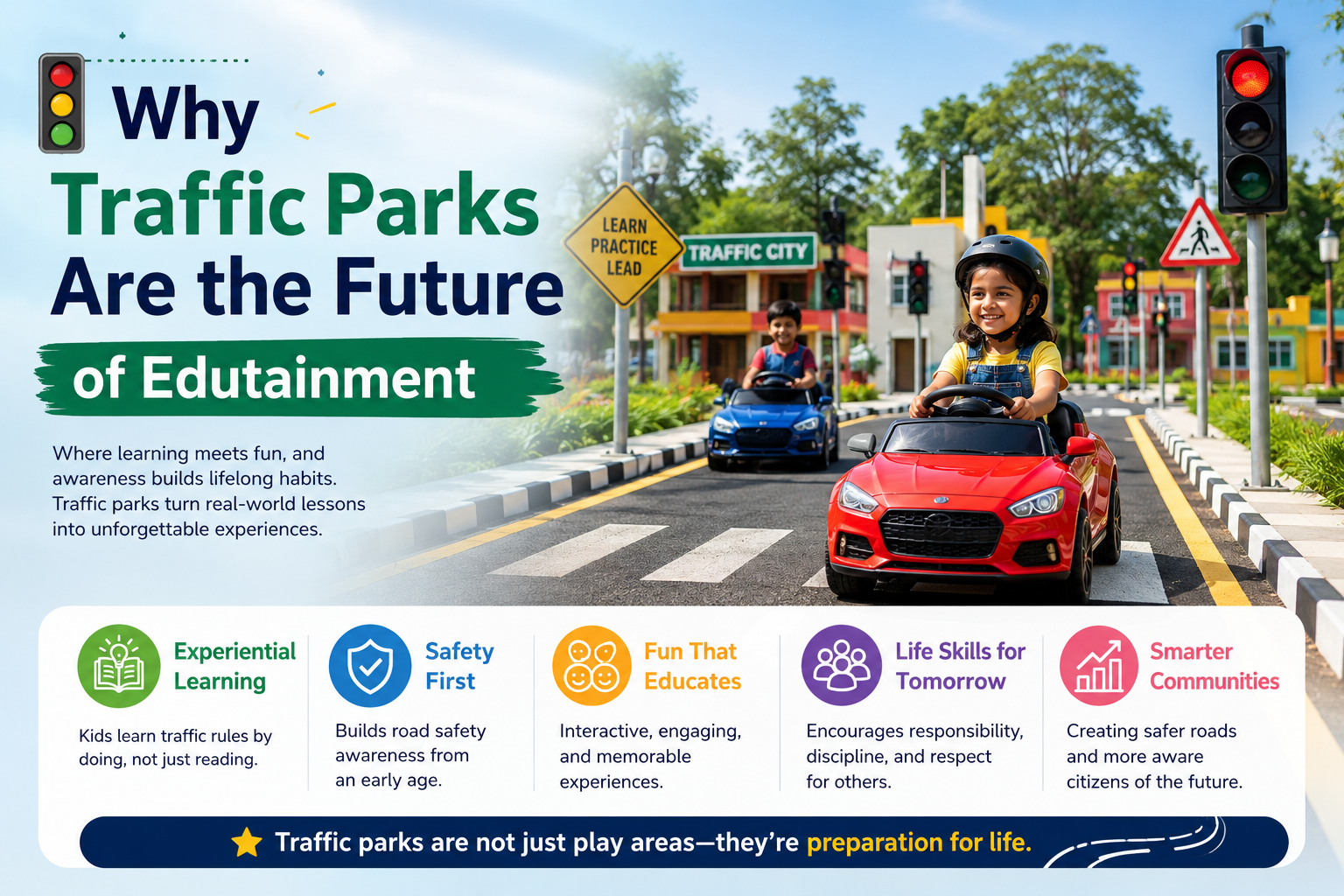
Why Traffic Parks Are the Future of Edutainment
�
�
Why Traffic Parks Are the Future of
Edutainment
Learning has grown far beyond textbooks and schools in modern times. The idea of
"edutainment," or education through entertainment, has grown to be an effective plan for
invigorating the minds of kids. Traffic Parks, interactive locations where kids and adults can
learn laws about traffic, road safety, and responsible travelling via pleasant, interactive activities,
are among the most unique use of using this approach.
There has never been such an urgent requirement for teaching people about traffic etiquette in a
useful, fascinating way as cities expand and roads get busier. Traffic Parks fill the vacancy by
bridge the gap between societal consciousness, education, and happiness.
�
�
What Is a Traffic Park?
A traffic park is a miniature reproduction of an actual road scene, complete with roads, traffic
signals, intersections for pedestrians, signage, and motors. These parks, which have been
created to simulate everyday driving circumstances give attendees—particularly kids—a safe
ability to explore mobility systems.
While learning how to understand traffic signals, follow lanes, and respect pedestrians rights,
users can drive tiny cars, ride electrified toy cars, or handle roads.
A traffic park is a living atmosphere for learning as rather than a conventional classroom. Every
lane marking, road sign, as well as light change becomes a part of a thorough safety and
responsibility training.
�
�
The Purpose: Learning by Doing
Traditional traffic education often relies on theory—rules written in books, charts, or lectures.
nevertheless this approach is unlikely to result in awareness in the real surroundings. When a
concept can be perceived, felt, or experienced, children learn it the best.
Experiential learning, a method of instruction to encouraging participation from students,
becomes practical by a traffic park. A child understands the lesson through action opposed to
memorization when they drive a tiny electric car though a traffic intersection or stop at a red
light.
Safety education becomes instinctive compared to an abstract principle attributable to this
combination of real-world knowledge and entertaining communication.
�
�
Why Traffic Parks Are Perfect for Children
For children, the idea of driving like adults is fascinating. When they step into a kid-sized traffic
park filled with toy cars, working signals, and real roads scaled down to their level, learning
becomes a game.
Here’s what makes it so effective:
● Hands-on Experience: Kids get to operate EV cars, bicycles, or mini jeeps in a safe,
controlled setting.
● Visual Learning: Traffic signs, colors, and motions help improve observation and recall.
● Moral Development: Concepts like patience, discipline, and empathy (e.g., giving
pedestrians the right of way) are naturally reinforced.
● Confidence Building: Driving simulations help children develop coordination and
decision-making skills.
This method of interactive education plants lifelong awareness about road safety and
responsibility—long before they start driving real vehicles.
⚙
The Role of Manufacturers in Building Better Traffic
Parks
Modern traffic parks are not just playgrounds; they are carefully planned spaces that call for
competence in development, manufacture, and safety legislation. Startups at the forefront of
developing such experiences is Kochi, state-based Ageless Entertainments.
Ageless Entertainments offers realistic, sturdy, and changeable traffic park vehicles and settings
with years of experience in amusement manufacturing. They include the items that follow:
● Electric Toy Cars & Jeeps designed for children’s use.
● Adult Training Vehicles for practical driving lessons.
● Traffic Signals, Signs, and Road Layouts built to mimic real-world conditions.
● Safety Infrastructure that ensures secure learning for all age groups.
These parks are also modular, allowing schools, municipalities, and private developers to scale
the layout—from a compact children’s zone to a full-fledged urban driving education center.
�
�
Edutainment: The New Learning Revolution
While the term "edutainment" sounds modern, the idea of teaching vital life skills via play and
stories is not novel. However, students' attention spans are getting shortening in the digital era,
and traditional teaching methods find it difficult keep the attention of pupils.
Traffic parks offer a great mix of leisure and learning. versus providing passive instruction, these
offer participation that is active.
Instant feedback: a little one learns swiftly when they fail to stop at a red light.
Children participate with others in team learning, sharpening their cooperation and social skills.
Simply put, traffic parks give education a memory that goes with students for longer than a
lecture in a classroom.
�
�
Beyond Kids: Traffic Parks for All Ages
While children are the primary focus, traffic parks are equally valuable for adults and new
drivers. Many modern parks integrate training simulators, two-wheeler practice tracks, and
pedestrian awareness programs.
Adults can:
● Practice driving in a low-risk environment.
● Learn emergency maneuvers safely.
● Refresh their understanding of traffic laws.
These parks can also serve as training hubs for delivery riders, bus drivers, and taxi
operators, contributing to safer urban mobility overall.
�
�
The Social Impact of Traffic Parks
Traffic discipline is not merely a personal skill—it’s a social responsibility. Every year,
thousands of road accidents occur due to negligence or lack of awareness. Traffic parks play a
crucial role in addressing this by:
● Promoting community awareness campaigns.
● Educating school groups through structured programs.
● Partnering with government departments and police forces to enhance public
engagement.
Such initiatives not only build safer citizens but also foster a sense of civic duty and
accountability—especially in younger generations.
�
�
A Sustainable Vision for the Future
Durability is a key consideration in the construction of today's leading traffic parks. These parks
show an commitment to social and environmental responsibility by using solar-powered
illumination, materials that are recyclable, and energy-efficient electric automobiles.
Manufacturers like Ageless Entertainments are heading the way in ecological friendly designs
that lower operations costs and inspire green learning. Examples of this designs involve electric
toy vehicles and low-maintenance park tools.
Traffic parks are an ideal complement for its objective to build safer, greener, and more sensitive
communities as global society goes toward advanced technology and environmentally friendly
development.
�
�
The Road Ahead
Traffic parks were an ideal fusion of recreation, education, and social impact. They leave an
ongoing impression that creates responsible citizens, safer drivers, and better-informed
communities.
Interactive events like traffic parks are unquestionably the method in which of the future for
edutainment, citing the growing concentration on technological innovation and experiential
learning. We're moving toward a generation that accepts and appreciates norms over merely
following them as more learning institutions, city governments, and brands of entertainment
adopt this framework.
Traffic parks are eventually about creating awareness, empathy, and safety via amusement
rather than merely providing rides and signals.
�
�
About Ageless Entertainments
Ageless Entertainments, based in Kochi, Kerala, is one of India’s leading manufacturers of
amusement rides and edutainment systems. From 12D theaters and trackless trains to EV toy
cars, traffic park vehicles, and water rides, the company continues to redefine the
amusement experience through innovation, safety, and sustainability.
With the brand philosophy “Ride Imagination,” Ageless Entertainments is helping cities and
institutions build a brighter, safer future—one joyful ride at a time.