
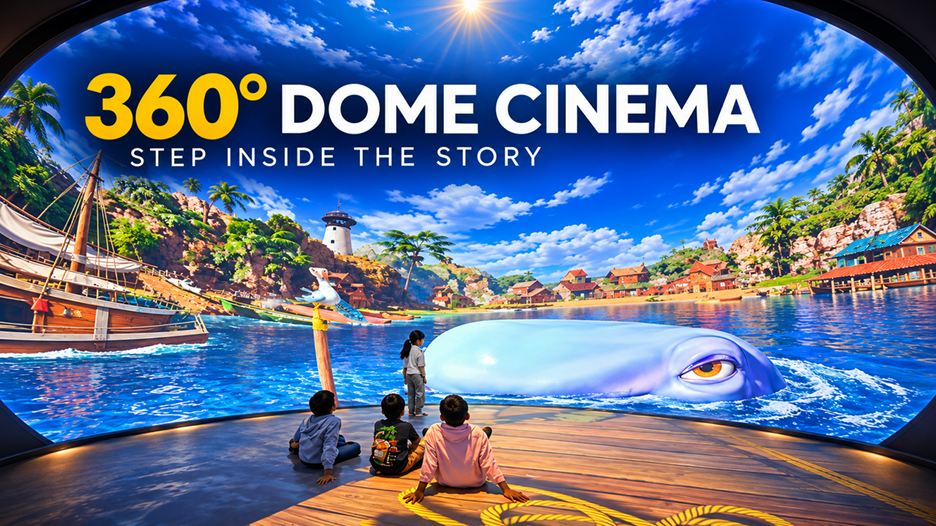
Imagine sitting beneath a sky filled with moving galaxies, exploring an underwater world, or flying above mountains without leaving your seat. A 360 projection dome brings these experiences to life by surrounding audiences with imagery across a curved screen. Instead of watching a rectangular display, visitors enter a shared visual environment that stretches around them and overhead.
For entertainment venues, museums, educational institutions, and event organizers, this format opens exciting creative possibilities. A well-designed dome combines visual storytelling, carefully planned projection, and sound to create an experience that feels larger than the room itself.
What Is a 360 Projection Dome?
A 360 projection dome is an immersive viewing space that uses a curved interior surface to display panoramic imagery. In a typical hemispherical installation, the screen extends around the audience and overhead. The term “360” generally describes the surrounding horizontal experience; it does not necessarily mean that images cover the floor.
Often associated with planetariums, full dome projection supports much more than astronomy. Digital systems can present animated environments, scientific visualizations, cultural stories, and cinematic journeys. Actual coverage depends on the dome’s shape, screen configuration, and projection design.
How Does Dome Projection Work?
A dome projection system brings together a curved screen, projectors, playback equipment, software, and audio. Content must be prepared and mapped for the screen’s geometry so that the intended scene appears correctly across the curved surface.
Depending on the installation, one projector or several projectors may deliver the image. Where multiple images overlap, alignment and edge blending help create a continuous picture. Screenberry, for example, describes automatic warping and blending for multichannel dome projection. The final experience depends on how effectively the equipment, software, screen, and content work together.
Why the Experience Feels Different
The appeal of an immersive dome theater begins with its scale. Images extend beyond the viewer’s central field of vision, encouraging people to look around and discover details. A passing spacecraft, a forest canopy, or an approaching ocean wave can become part of the surrounding environment.
The experience is also shared. Families, classmates, and groups can watch together without wearing individual headsets. Their reactions become part of the occasion. For creators, this makes the dome an interesting setting for stories built around wonder, exploration, suspense, and collective discovery.
Entertainment and Visitor Attractions
A 360 projection dome can become the centerpiece of a visitor attraction. Creative concepts might include a journey through space, a prehistoric adventure, an underwater expedition, or an animated flight through an imaginary landscape. Each setting offers opportunities for storytelling that uses the entire dome.
Successful programming needs more than impressive visuals. A clear narrative, appropriate show length, comfortable viewing, and thoughtful pacing help give visitors a satisfying experience. For venues considering several shows, varied themes can also provide reasons for different audiences to visit and explore the attraction.
Education Through Exploration
Educational dome experiences can place a subject around the audience. An astronomy presentation might guide students between planets, while an environmental story could take them through a rainforest or beneath the sea. Presenters can use these environments to introduce questions and explain relationships.
However, visual impact alone does not guarantee learning. Educational content should have clear objectives, accurate information, readable graphics, and language suited to its audience. Time for explanation and discussion matters too. The strongest learning experiences connect the spectacle to ideas that students can understand, question, and remember.
Museums, Heritage, and Tourism
Museums and cultural destinations can use dome storytelling to introduce visitors to places, people, and historical settings. A presentation might explore a reconstructed ancient settlement, a regional landscape, or a carefully researched account of a community’s traditions.
Tourism experiences can similarly offer a visual introduction to a destination. Mountains, coastlines, architecture, and festivals provide rich material for immersive films. Such projects work best when local knowledge guides the narrative. Historical reconstructions should distinguish established evidence from interpretation, while cultural representations should reflect the people and places being portrayed.
Brand Experiences and Events
For exhibitions and corporate events, a projection dome provides a setting for a focused presentation. Visitors could step inside a visual story about a product, explore an architectural concept, or experience an artistic interpretation of a brand’s identity.
The message should remain easy to follow. Filling every surface with logos, text, and fast movement can overwhelm an audience. A more effective approach gives each scene a purpose, uses a clear visual focus, and allows enough time for the central message to register. The environment should support the story throughout.
Planning a 360 Projection Dome
Planning begins with the intended audience and purpose. A school outreach installation, a permanent museum theater, and a temporary event dome have different operating needs. Available space, audience capacity, access, ventilation, acoustics, and maintenance arrangements all deserve attention early.
Projection quality also involves more than a resolution label. Image brightness, contrast, screen characteristics, alignment, and the viewing position affect what visitors actually see. When evaluating a proposed installation, reviewing representative content from several seats can help reveal practical differences that equipment specifications alone may not communicate.
Content Makes the Difference
A curved screen needs content designed for its viewing conditions. Simply stretching a conventional video across a dome may produce an awkward composition. Important action should remain easy to locate, and text should be limited and positioned thoughtfully.
Movement needs particular care. Rapid camera turns or prolonged simulated motion may feel uncomfortable for some viewers. Gentle transitions, deliberate pacing, and audience testing help refine a show. Good sound design adds another layer, supporting the direction, atmosphere, and emotion of the visuals without making narration difficult to understand.
Bringing Immersive Ideas to Life
A 360 projection dome offers a creative platform for shared experiences across entertainment, education, heritage, and events. Its value comes from bringing the venue, technology, content, and audience together around a clear purpose.
Whether the goal is to explore the universe, introduce a destination, or tell an imaginative story, the strongest result begins with thoughtful design. When every element supports the experience, the dome becomes more than a screen: it becomes a place where audiences can step into a story together